1 It was now two days before the feast of the Passover and the unleavened bread, and the chief priests and the scribes sought how they might seize him by deception, and kill him. 2 For they said, “Not during the feast, because there might be a riot of the people.” 3 While he was at Bethany, in the house of Simon the leper, as he sat at the table, a woman came having an alabaster jar of ointment of pure nard—very costly. She broke the jar, and poured it over his head. 4 But there were some who were indignant among themselves, saying, “Why has this ointment been wasted? 5 For this might have been sold for more than three hundred denarii, and given to the poor.” They grumbled against her. 6 But Jesus said, “Leave her alone. Why do you trouble her? She has done a good work for me. 7 For you always have the poor with you, and whenever you want to, you can do them good; but you will not always have me. 8 She has done what she could. She has anointed my body beforehand for the burying. 9 Most certainly I tell you, wherever this Good News may be preached hroughout the whole world, that which this woman has done will also be spoken of for a memorial of her.”
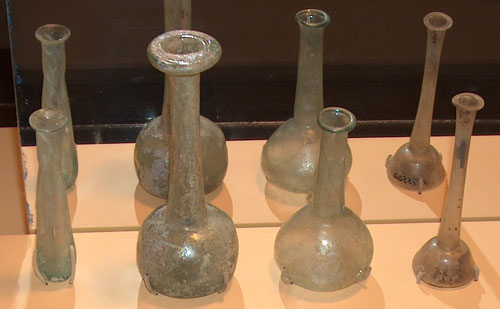
Early Roman Glass Unguentarium -- Smithsonian Collection, Washington
DC
These type of Roman era glass bottles were found in tombs from the first through third centuries in Israel. They were called unguentarium or ointment vessels. Beginning in Greek time there were alabaster ointment/perfume vials made of alabaster called alabastron. In the times of Jesus there were vials of ceramic/pottery or glass origin although they were called alabastron. The dead were anointed with he perfume or sweet smelling ointment and the bottles were left in tombs.
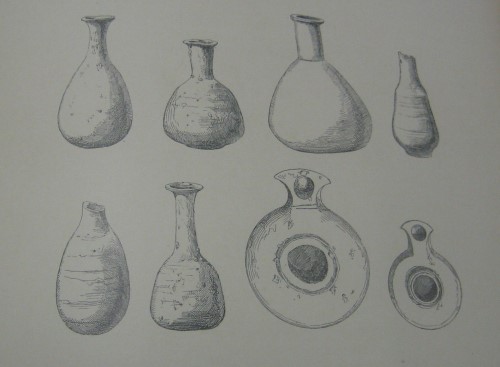
During 1873-1874 a French Semitic scholar named Clermont-Ganneau excavated some Herodian era tombs in the Wadi Yasul and Wadi Beit Sahur areas in the vicinity of Jerusalem. He found some lamps and clay bottles left behind. These shapes resembled some of the glass bottle shapes in the photo above. Since the Jews thought corpses were unclean and anything in a tomb was unclean they had to leave the vessels they took to the burial sites in the tombs. The use of alabastron during those days was consistent with the Gospel account.
Nazareth Synagogue
Churches of the Annunciation
Latin Tradition -- Mount of Precipitation
Nazareth Aerial View
Museum of the Basilica
Hot Springs at Tiberias
Stone Water Jars at Capernaum
Capernaum
Tabgha
Bethsaida
A 1909 Galilee Fishing Description
The Giant Mustard Plant
Kursi and the Gadarene Demoniac
Jar of Ointment
Cana
Wheat and Tares