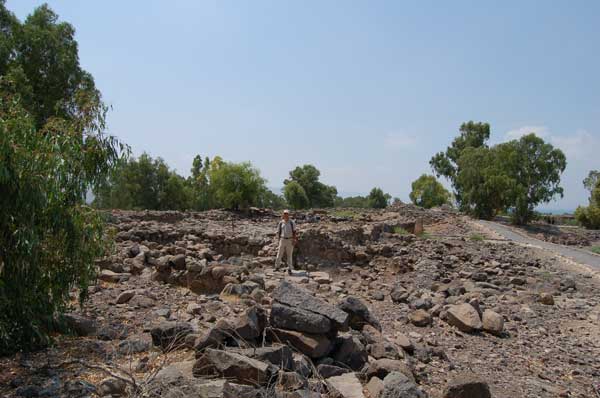
Remains of the Et Tell thought to be Bethsaida -- Basalt Building Blocks
ISRAEL PHOTOS IV -- Pilgrimage |
El Araj along the shore of the lake near the mouth of the Jordan River has been recently identified as a probable location for Bethsaida after recent excavations revealed a Roman era bath house and artifacts dating from the first to third centuries. In 1998 Mendel Nun reported finding a Herodian era lamp at El Araj. This region has a history of severe earthquakes that may have changed the lake level over two thousand years. In 1837 an earthquake destroyed much of Tiberias and Safed killing thousands and leveling many houses. In 1927 an earthquake killed hundreds in this area (8/7/17 insertion).
Bethsaida was listed as the home of the disciples of Jesus named Philip, Andrew, and Simon. In one Gospel, Bethsaida was in the region where the feeding of the 5,000 occurred. A blind man was healed near Bethsaida. Jesus listed Bethsaida as an unrepentant city. Philip, the brother of Herod Antipas, may have built his winter residence at Bethsaida. According to Josephus he was buried there. Herod Antipas, ruler of Galilee, built his provincial capitol on the other side of the lake at Tiberias and named his town Tiberius.
Bethsaida Gaulonites is evidently spoken of, the ruins of which have been recognized by Dr. Eli Smith and other travelers on a hill
called et-Tell, on the east bank of the Jordan, close to the northern shores of the lake. Josephus calls this Bethsaida-Julias, and informs us that Philip the
Tetrarch of Iturea and Trachonites gave it this epithet in honour of Julias, having enlarged the town, and adorned it with public buildings.
Syria and Palestine, in 1851 and 1852, Van de Velde (1818-1898), 1854, Vol II
Pliny wrote that Julias (Bethsaida) and Hippos were on the east side of the Jordan. Julias may have been named after Augustus' daughter.
Remains of the Et Tell thought to be Bethsaida -- Basalt Building Blocks
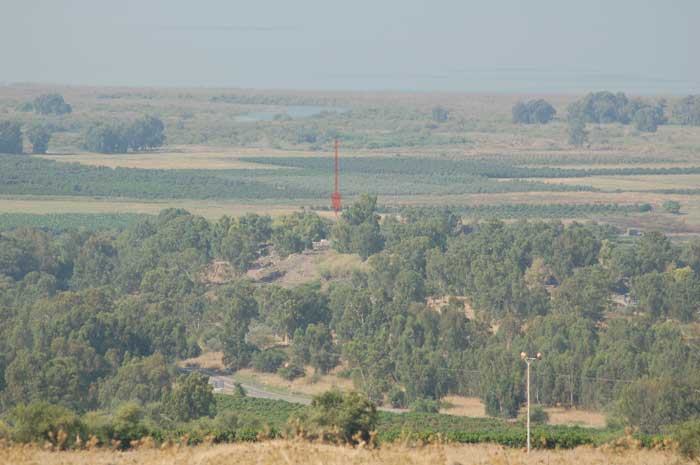
Et Tell - Previously thought to be Bethsaida.
Bethsaida may have been near a Roman road from Damascus to the Mediterranean Coast. A survey of coins found at nearby Capernaum included coins from Syria, Asia Minor, and Cyprus within the Roman empire. Syria bordered on the Euphrates and areas to the east within the Parthian empire. Bethsaida was a border town where tax collectors may have collected tolls from travelers. According to Tacitus the provincial governors used Publicani (contractors) to collect indirect taxes for provincial government projects while the Romans used their own government agents to collect direct taxes for Rome. A Roman road was discovered by some archaeologists as between Capernaum and Et Tell. The Jordan River ford was easier near Et Tell. One pilgrim indicated there was probably a Roman bridge at one time. Centuries of sometimes intense flooding and earthquakes may have erased any traces of such a structure. A hill top survey of areas near the fifty foot high Et Tell indicate other buildings were built in the regions adjacent to the hill.
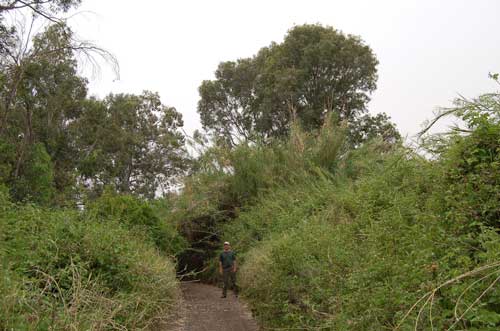
In the Jordan River delta below Bethsaida there were nearly impenetrable areas The reeds in the background were nearly twenty feet high. The area had a long history of malaria. Horsemen found the footing difficult in the winter as frequent rains created mud holes. The seasonal stream channels contained numerous boulders and cobbles making for difficult passage across other areas in the delta. In the days of John MacGregor there was a ford of the Jordan River close to Et Tel as the way by the shore was not easily passable.
In the 19th century Macgregor measured the mouth of the Jordan as 70 feet wide. He noted a ford in the marsh of the delta. He recorded there was a more popular ford about a mile and a half upstream where he saw people crossing and this was probably where Jesus’ followers crossed as they followed along the shore of the lake toward the location of the feeding of the 5,000. The location of the feeding of the 5,000 was presumed by a majority of pilgrims whose books I read to have occurred along the shore of the lake east of the Jordan River. A Canoe Cruise in Palestine, Egypt, and the Waters of Damascus, The Rob Roy on the Jordan, by J. MacGregor, 1870
Nazareth Synagogue
Churches of the Annunciation
Latin Tradition -- Mount of Precipitation
Nazareth Aerial View
Museum of the Basilica
Hot Springs at Tiberias
Stone Water Jars at Capernaum
Capernaum
Tabgha
Bethsaida
A 1909 Galilee Fishing Description
The Giant Mustard Plant
Kursi and the Gadarene Demoniac
Jar of Ointment
Cana
Wheat and Tares